Newsletter Archive
Pinky Up Thursday — Do you need a writing schedule? Maybe, Probably, Yes
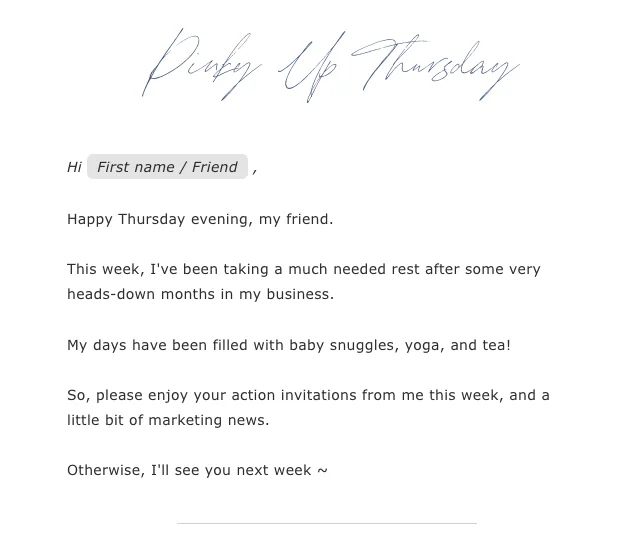
Happy Thursday evening, my friend. This week, I’ve been taking a much needed rest after some very heads-down months in my business. My days have been filled with baby snuggles, yoga, and tea! So, please enjoy your action invitations from me this week, and a little bit of marketing news. Otherwise, I’ll see you next week ~
Action Invitation: Set your writing schedule.
Writing weekly blog content sounds exhausting. But, truthfully, once you have a schedule, a system, and your SEO content strategy, the rest is pretty simple. So, it’s time to consider your blog writing schedule. This week, it’s time to set yours.
Here’s a writing time block sample schedule (Goal: 1 weekly blog):
- Outline time: 1 hour time block
- Writing time: 3 hours broken into 2 time blocks
- Posting and Optimizing time: 1 hour time block
Here’s a weekly writing sample schedule:
- Monday: 1 hour outline block (60 minutes)
- Tuesday: 1 writing time block (90 minutes)
- Wednesday: 1 writing time block (90 minutes)
- Thursday: 1 posting block (60 minutes)
- Friday: Repurpose for social media
The more blogs or articles you want to publish per week, the more you can adjust your writing schedule. You can also create larger or smaller blocks for yourself, depending on how you work best. For example, if you’re a person that needs a lot of warm-up time, you might want to accommodate for the extra time it will take you to mentally get into the writing headspace. If you write professionally already, you’ll probably be able to write faster and with more efficiency, meaning you can accommodate more writing blocks and more pieces of content.
Check out the blog below for more details, and send me your blog schedule once you’re done! I’d love to see it.
Workshop Waitlist: Own Your Organic SEO
In this free workshop (dates TBA), we’ll go over 5 Ways to Grow Your Website Presence. You’ll learn how you can show up for your target search terms and how to maximize your organic website footprint at each stage of your strategy.
Lessons of the Week (and AMA)
🎙️ URLs for SEO performance — A quick tip for URLs is to keep them shorter and sweeter. If you’re wondering what to name your page URL (sometimes called the “slug”), opt for the shorter version of your page title. So, instead of /what-color-should-I-paint-my-bedroom, you could name the page /bedroom-color-ideas. There’s a bit of an art to naming your URLs, and in general, you want to name them according to their subject matter, page type, target keyword, search intent, and other factors. Remember that each URL slug is unique!
🎙️ Redirects: What the Heckinbob Are They? — Don’t forget your redirects! Redirects tell Google, “Hey! The page that was previously called /what-color-should-I-paint-my-bedroom is now called /bedroom-color-ideas. Don’t miss it!” They also direct your old URL to the new URL automatically, so you don’t have to update the old URLs for people to find your new URL. This is especially important in a site migration or content pruning exercise. To implement a redirect, check your CMS options. For WordPress, you can download redirect plugins that manage it all for you. Different options are available depending on your tech stack. (A quick Google search will help you figure it out for your particular CMS. Ex. “how to redirect page with Shopify”.)
🎙️ Content Pruning: Checking In On Your Content — Content pruning is what you can do every 3, 6, 12, or 18 months. It involves taking a closer look at all your content performance metrics and deciding what changes need to be made (if any). Generally, irrelevant pages, poor performers, and pages within reach of your target keywords (but just out of touch) can be cleaned up, edited, redirected, or unpublished. But be careful how much you change or unpublish, since any changes to your website can impact performance. (Always consult with a professional to account for content pruning risks.)
Any of these lessons sound interesting to you? AMA by replying to this email.
On the Blog
How to Maximize Your Weekly Blog Schedule
That’s all for now! Do you have a writing schedule? What day do you write best? Reply to this email with the challenges you’re facing with your writing schedule!
Hasta la pasta, Crystal Ortiz

Is this newsletter helpful? Invite a friend. I’d love for you to share the newsletter link.